Tell us about the job
Takes about a minute. No obligation.
Gas water heater repair in Uinta County begins at the vent connection and the combustion air path, not the burner itself. Utility gas heats more occupied homes in Uinta County, Wyoming than any other fuel, at 62.9% (2020-2024 ACS 5-year). A contractor working on a gas unit here checks the flue for blockage or backdrafting before touching the ignition system, because a burner that lights correctly but vents poorly will fail again on the same call. Sediment accumulation and anode wear follow from the local water chemistry and from how hard the unit runs, but those show up in the tank. A compromised vent is the fault that produces carbon monoxide and a callback.
Water heater repair in housing this old rarely stops at the unit. Half the homes in Uinta County, Wyoming were built in 1984 or earlier (2020-2024 ACS 5-year). A house built that long ago was plumbed around equipment and materials that have since been discontinued, and what surrounds a water heater, the supply lines, shutoff valves, and flue connections, tends to be in the same condition as the heater itself. A contractor opening the job often finds that fixing the heater means addressing what feeds and vents it too.
The Parts of a Water Heater a Contractor Checks First
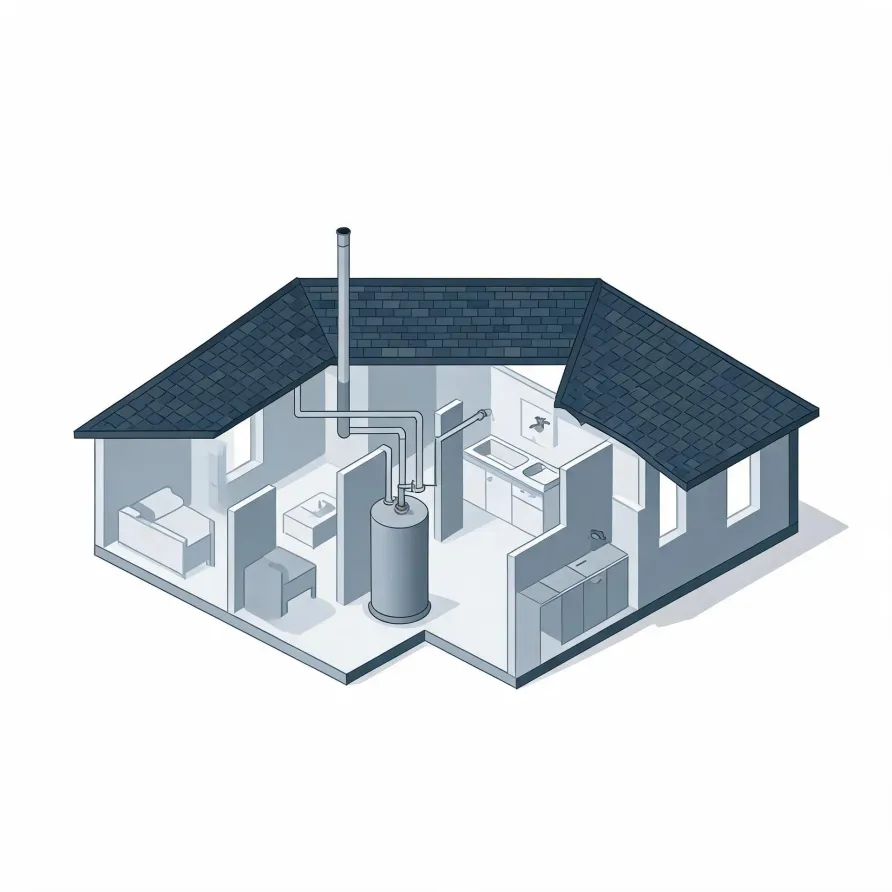
The tank is what most homeowners picture: a large insulated cylinder that sits in a utility closet, basement, or garage and holds a supply of heated water ready for the house. Inside it, a burner or heating element does the actual heating work, and a thermostat tells that element when to run and when to stop.
The pressure relief valve sits on the side or top of the tank and opens automatically if pressure inside builds past a safe point. The anode rod hangs inside the tank and slows corrosion of the tank walls. The dip tube carries cold incoming water to the bottom of the tank, and the flue or exhaust vent carries combustion gases out of the house on gas-fired units.
The drawing shows a typical layout, and a licensed contractor determines which parts apply and what condition they are in for this specific house.
Find a contractor in Uinta CountyUinta County, Wyoming, by the numbers
62 severe weather events were recorded in Uinta County, Wyoming between 2015 and 2024.
NOAA National Centers for Environmental Information, Storm Events Database, bulk CSV export, events 2015-01-01 through 2024-12-31.Half the homes in Uinta County, Wyoming were built in 1984 or earlier (2020-2024 ACS 5-year).
U.S. Census Bureau, 2020-2024 American Community Survey 5-Year EstimatesUinta County, Wyoming holds 8,901 housing units (2020-2024 ACS 5-year).
U.S. Census Bureau, 2020-2024 American Community Survey 5-Year EstimatesOwners occupy 76.6% of the occupied homes in Uinta County, Wyoming (2020-2024 ACS 5-year).
U.S. Census Bureau, 2020-2024 American Community Survey 5-Year EstimatesSevere Weather Events in Uinta County
Uinta County's climate puts real stress on water heaters, and that stress compounds when extreme weather hits. Repair demand in this area tracks local conditions, so the weather record below is part of the picture.
62 severe weather events, 2016–2024. Source: NOAA National Centers for Environmental Information, Storm Events Database.